
Multi-store stock, on every product page.
If you run a powersport retail chain with multiple physical stores, your customers want to know which location has the part they need before they drive there. PowersportOS makes that work natively, not as a custom integration project.
The problem
"Which of your stores has this in stock?"
Customers ask this question every day. Most multi-location retailers can't answer it on the product page. They have to call each store, or maintain manual stock-per-location lists that drift, or just say "one of our stores probably has it" and hope.
Building the infrastructure to show per-store stock on a product page is a year-long internal project at most retail chains. PowersportOS makes it a standard feature.
How it works
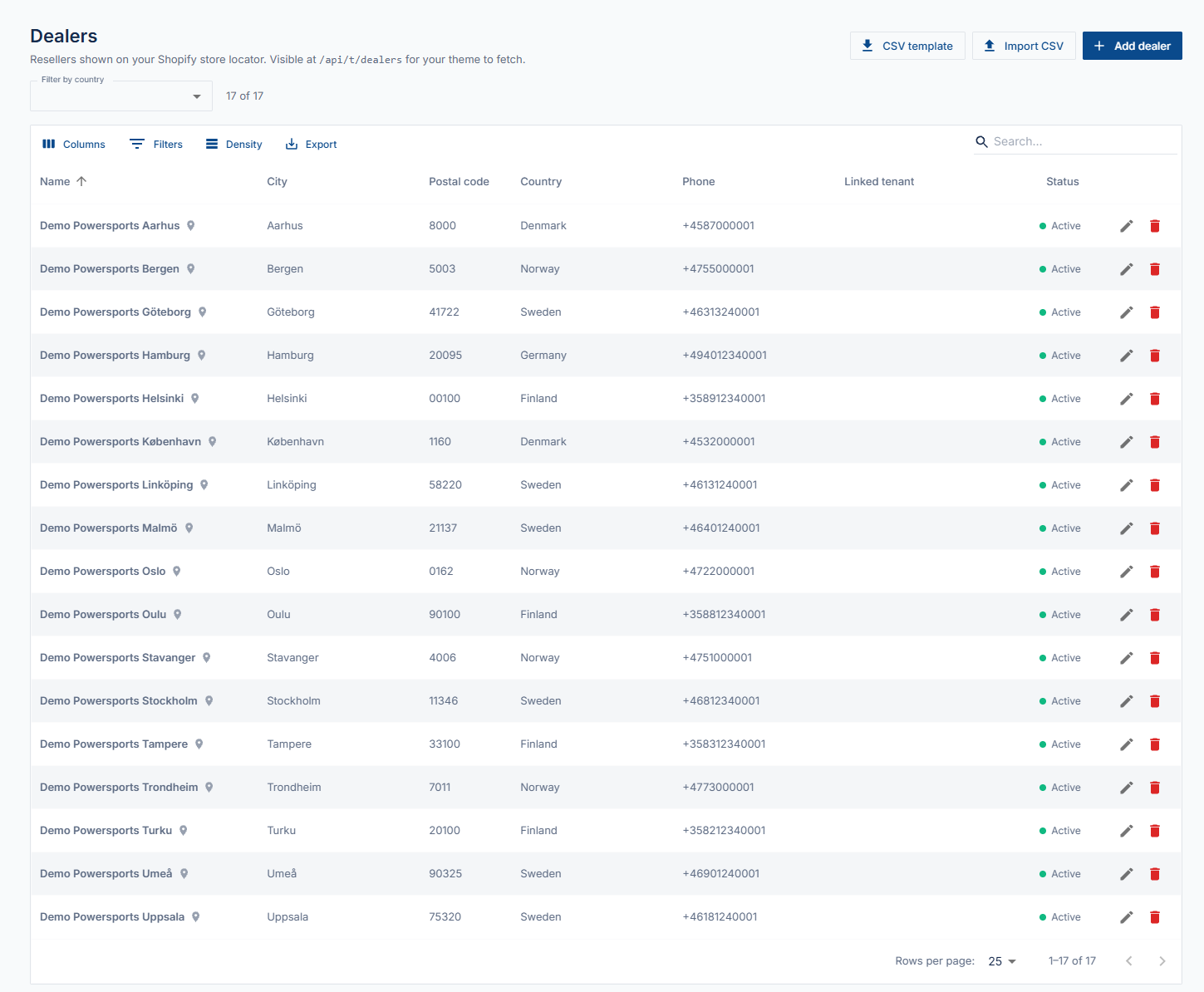
One stock-feed endpoint per location.
Each store keeps its own stock
Your POS / ERP / inventory system pushes per-location stock via a single API endpoint:
POST /api/integrations/location-stock with payload [{ dealerId, partNumber, stock }] (API docs). PowersportOS validates that each dealerId belongs to your tenant, persists the per-location row, and serves it back on the customer-facing widget within seconds.
No batch files, no nightly sync. Your existing systems push in real time.
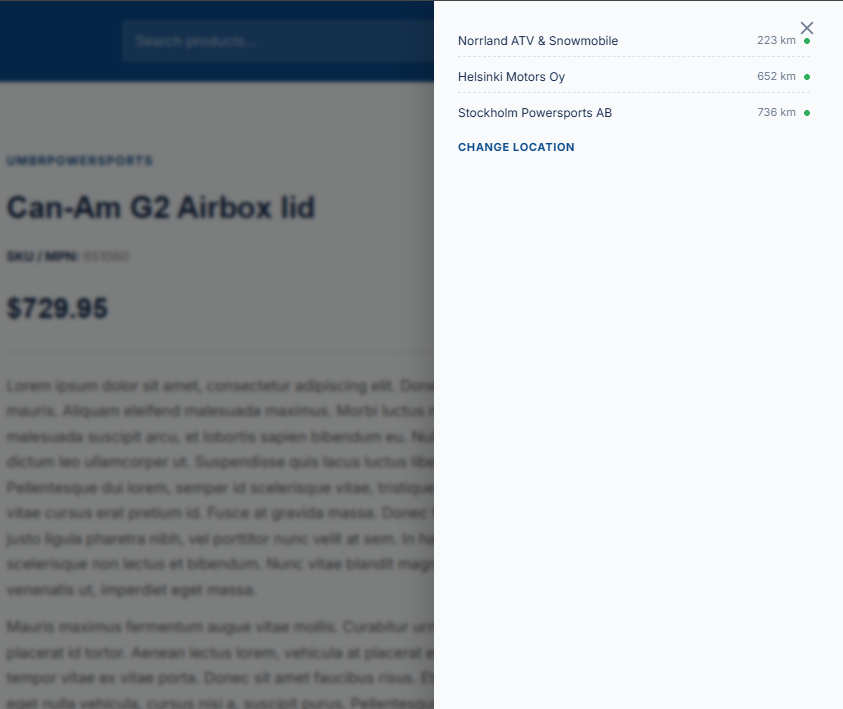
Product pages show nearest-store availability
The same Shopify theme module that powers "find this part at a reseller near you" on manufacturer sites, repurposed for your own chain. Customer's browser location → nearest stores ranked by distance → live stock per location.
Haversine sorting, opt-in customer geolocation, falls back to a list-view when geolocation declined.
Same central catalog as single-store retailers
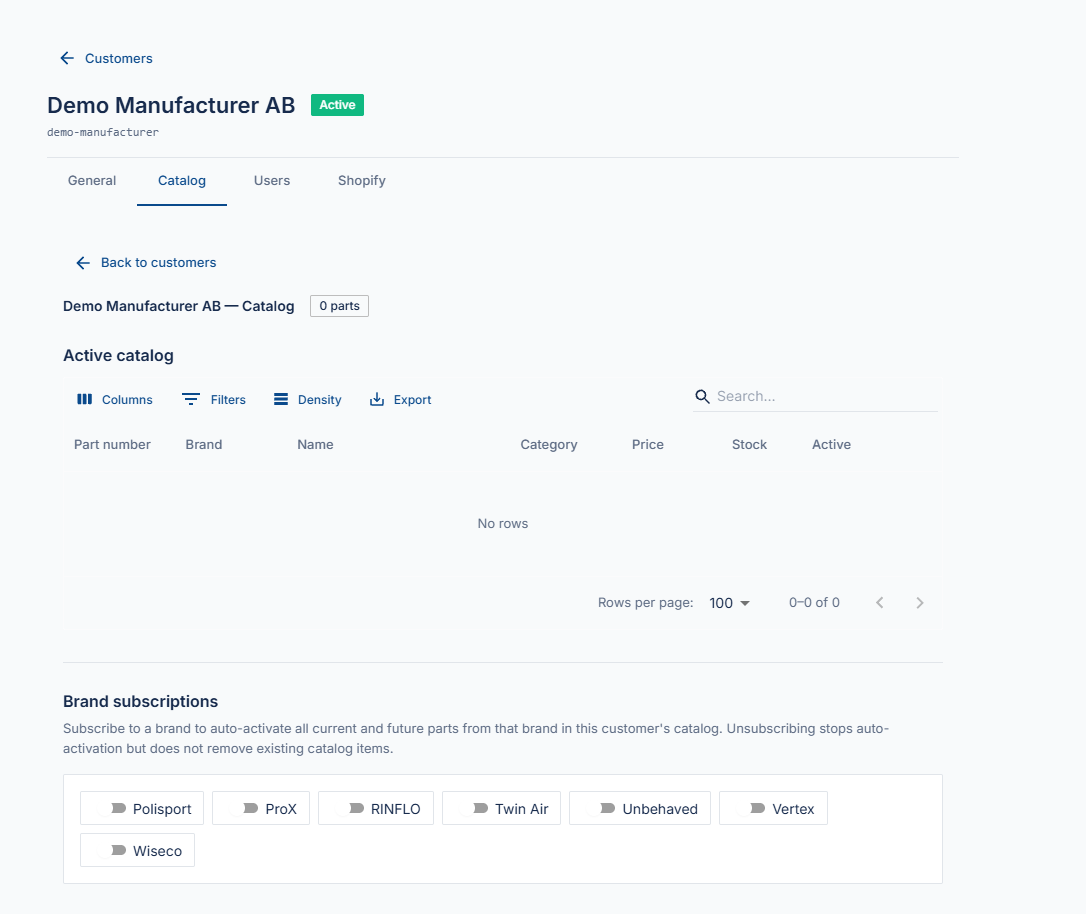
Subscribe to brands, get pristine product data flowing to your storefront. The stock-per-location layer is additive on top of the regular catalog. It doesn't compete with the catalog, it extends it. Same Shopify theme, same fitment widget, same product pages, all chain-aware.
multi-store
Running several separate Shopify storefronts?
Multi-location stock is the right fit when you have one Shopify store and several physical locations under it. If you instead run several separate Shopify storefronts (regional sites, B2B and B2C splits, market-specific variants), Multi-Store is the layer for that case: one canonical catalog on a parent tenant, child storefronts pulling subsets with their own pricing and stock per item.
The two layers compose: a chain can be Multi-Location (per-store stock on a single Shopify) AND Multi-Store (running a separate B2B storefront in addition). Read the Multi-Store guide for the data model.
Content from your brands, chain-wide
One safety recall, one acknowledgement, every store covered.
Multi-location retail has a content problem that single-store dealers don't: when a manufacturer issues a safety recall on a SKU range, you need to know that every store stopped selling it and that the right person at chain HQ acknowledged the notice on behalf of the whole organisation. Channel Communications gives you that single acknowledgement workflow for the whole chain.
Single chain-level acknowledgement
Safety recalls force-deliver to the chain (not per store) with a persistent red banner across the portal until an owner or admin acknowledges. Parallel email to your technical contact. 48-hour SLA per the Channel Subscriber Terms. The forensic trail captures who acknowledged on the chain's behalf, with IP and user-agent recorded for any post-recall audit. Per-store actions (stopping sales, customer notification) are still your responsibility under applicable consumer-protection law; the platform makes the central acknowledgement step bulletproof.
Brand content lands once, applies everywhere
Blog posts, product-release digests, operational alerts from the manufacturers and distributors you carry flow into a single chain inbox. Approve once, publish to your storefront. No duplicated approval workflow per store, no risk that one store gets the post and another doesn't. Architecture
Why this matters
The feature only enterprise has, until now.
Multi-location stock on product pages is a feature today's powersport retailers only see from the absolute biggest players: pan-European chains with internal dev teams and Salesforce contracts. Mid-size chains (5-20 stores) end up either writing custom integrations against generic e-commerce platforms or accepting that this is a feature they can't have.
PowersportOS makes it a standard part of the platform. Sign up for the RETAIL tenant type, push stock to the location endpoint, the widget is on your product page. That's the entire setup.
Ready to talk?
Multi-location chains have unique requirements (POS integration, sometimes EDI, sometimes nightly stock batches). Tell us how your operation looks and we'll show you what the path to live looks like.